
If you are building a home, replacing a furnace or moving to a house outside town, you will probably face a choice between propane and natural gas. Both are clean-burning fuels, both run the same kinds of appliances, and both are often just called “gas.” The real differences come down to how the fuel reaches your home, how much heat it delivers, and what is available on your street. Here is a plain look at each so you can decide what fits.
What Is Propane?
Propane is a hydrocarbon fuel produced during natural gas processing and oil refining. It is a gas at normal temperature and pressure, but it turns into a liquid under moderate pressure, which makes it easy to store and transport. That is why you will also see it called liquefied petroleum gas, LP gas or LPG. Propane is delivered by truck and stored in a tank on your property, either above ground or buried.
What Is Natural Gas?
Natural gas is mostly methane. It is piped from a utility’s distribution network directly into your home, and you pay the utility for what you use each month. If there is no gas main on your road, natural gas is not an option without the utility extending its lines, which can be costly or simply not offered.
Propane vs Natural Gas at a Glance
Availability
This is the deciding factor for many homeowners in eastern Connecticut, Rhode Island and Massachusetts. Many smaller towns and rural roads have no natural gas lines. Propane works anywhere a delivery truck can reach, so it gives you gas heat, hot water and cooking even where the utility does not go.
Heat Content
Propane carries about two and a half times as much heat per cubic foot as natural gas. That does not mean you need less fuel for the same comfort, because appliances are built and adjusted for the fuel they burn, but it does mean propane equipment and natural gas equipment are not interchangeable without a conversion. Many furnaces, boilers, water heaters and ranges can be converted from one fuel to the other with the right kit and a qualified technician.
Cost
Comparing price per gallon of propane with price per therm of natural gas is not a straight line, and both change over time. The better comparison is what it costs to heat your specific home with an efficient system. A local supplier can help you look at your expected usage, your equipment and payment options such as propane payment plans that spread costs over the year.
Control and Reliability
With natural gas you depend on the utility’s network. With propane, your fuel supply sits on your property, which many homeowners like during storms. A propane tank can also fuel a standby generator, so you can keep heat, lights and a refrigerator running when the power goes out.
Safety and the Environment
Both fuels are safe when equipment is installed and maintained properly. Propane is non-toxic and does not harm soil or water if it leaks, and it is recognized as a clean alternative fuel under the 1990 Clean Air Act. Natural gas and propane both have an odorant added so you can smell a leak. Our propane safety tips page explains what to do if you ever smell gas.
Which One Is Right for Your Home?
If your home already has a natural gas line and your equipment runs on it, there is often little reason to change. If there is no gas main nearby, or you want your own fuel supply for heating, a generator, a fireplace or a pool heater, propane is usually the practical choice. Homes that heat with oil also switch to propane when it is time to replace an aging boiler or furnace.
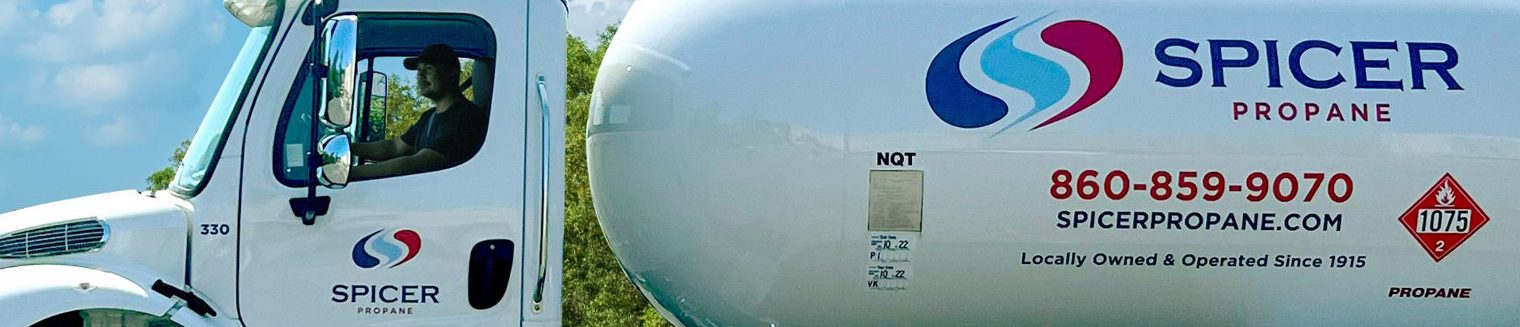
Spicer Propane has delivered fuel to homes and businesses since 1915. We install propane tanks from 30 to 1,000 gallons, offer automatic propane gas delivery, and our service division, Spicer Energy Services, installs and services propane furnaces, boilers and water heaters. See the towns we serve or learn how to switch to Spicer Propane.
Frequently Asked Questions
Is propane the same as natural gas?
No. Propane and natural gas are different fuels. Natural gas is mostly methane delivered by pipeline, while propane is stored as a liquid in a tank on your property and delivered by truck.
Can I use propane in a natural gas appliance?
Not as is. Propane and natural gas burn at different pressures, so an appliance has to be set up for the fuel it uses. Many appliances can be converted with a manufacturer kit installed by a qualified technician.
Is propane a gas or a liquid?
Propane is a gas at normal temperature and pressure. It is stored as a liquid under pressure in your tank and turns back into vapor when it flows to your appliances.
Does propane work where there is no natural gas line?
Yes. That is one of its biggest advantages. Propane is delivered to a tank at your home, so you can have gas heat, hot water and cooking in areas without gas mains.
Who delivers propane gas in eastern Connecticut?
Spicer Propane delivers propane gas to homes and businesses in eastern Connecticut, Rhode Island and south-central Massachusetts, with offices in Groton and Putnam, CT. Call 860-590-4816 to set up delivery.